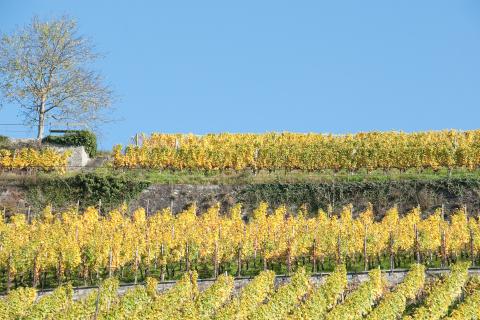
Early opinion of the 2009 Swiss wine vintage was “promising”, but by the end of the year the federal agriculture department near Nyon officially declared it as “excellent” for both quality and quantity.
For most of Switzerland the weather played nice. The early budding in spring, helped by a hot and dry June, led to quick flowering. A dry late summer and early fall helped the grapes mature well, and the weather stayed friendly for the harvest.
There were some problem patches: for example a 15-minute hail storm in July in the La Côte region damaged some vine parcels. But generally the good season made up for it, with the nearly 15,000 hectares of vines in Switzerland yielding 1.1 million hectoliters, 35,000 more than the previous year.
Published 21 June 2010 in Swiss Wine Travel and Lifestyle - Wine Appreciation
Interested in tasting wines at Ticino wineries? How about hiking with a St. Bernard through Valais vineyards? From mainstream to unusual, here's a collection of links for travelers interested in Swiss wine.
Read more: 15 ways to explore the world of Swiss wine
Published 27 May 2010 in Swiss Wine Travel and Lifestyle - Wine Touring
Wine information is easy to find. Swiss wine information is somewhat more elusive, and Swiss wine information in English is rare. So I have been eagerly waiting for the release of the first English version of the Swiss Wine Guide At last it is here.
Read more: 2009 Swiss Wine Guide
Published 22 May 2009 in Swiss Wine Travel and Lifestyle - Wine Appreciation
“So how good was the 2008 Swiss wine harvest?”
Well, thank you for asking, because it was a close one. The hail storms in some areas of Switzerland didn’t cause too much damage, but the bad weather in the early fall had the Swiss wine growers skittish. Fortunately Bacchus proved accommodating. A pleasant Indian summer followed with gentle breezes and sunny days. In the end the Swiss wine growers were more than satisfied.
Warm sunny days and cool evenings are ideal for wine grapes. The grapes are able to mature, develop excellent sugar levels, and be harvested at the best time of the year. Although, “not the best we've seen these past ten years," says Thierry Walz, a member of the Swiss Wine Exporters' Association, but comparable to 2006, one of the best recent vintages. The Chasselas and Pinot Noir grapes particularly benefited.
Yields were 3.5% higher as well, according to the Swiss Department of Agriculture, up roughly 35, 000 hectoliters to 1, 075,561 hectoliters .
Published 22 February 2009 in Swiss Wine Travel and Lifestyle - Wine Appreciation
The following has been added to the Swiss Wine Grape Listing:
Muscat Ottonel a.k.a. Chasselas Saint-Fiacre, Mirisavka, Mirislavka, Muscat de Craciunel Tîrnave, Tamîiosa Ottonel
Muscat Ottonel is a member of the Muscat family. Used for dry wines in Alsace and Hungary, and dessert wines in Austria and Croatia. In Switzerland it is usually used for light, dry wines. It’s parentage is believed to be the Muscat de Saumur and Chasselas.
Style: Dry light through Sweet dessert wines
Origin: France (probably)
Muskat Canelli
Muskat Canelli made its way from Italy to Valais, where it has limited production, and produces a dry white wine.
Style: Dry light through Sweet dessert wines
Origin: Italy (probably)
Nobling
Nobling is a cross between Silvaner and Gutedel (Chassalas) from Staatliches Weinbauinstitut at Freiburg. It’s being tested in Valais and can be found in retail.
Style: fruity and complex wines with a delicate bouquet and fine acidity
Origin: Germany
Pinot blanc a.k.a. Weissburgunder, Fehér Burgundi (Hungary), Pinot bianco (Spain and Italy), Rulandské Bilé (Czech), Rulandské Biele (Slovak)
Pinot blanc is a mutation of pinot gris. It may have found its way up the Rhône to Valais with any number of mercenaries returning to Switzerland, and today small quantities are cultivated in many Swiss wine regions.
When grown in favorable conditions it produces a fruity wine with good acidity.
Style: Light to fruity wine
Origin: Germany
Published 17 February 2009 in Swiss Wine - Grapes